

Angle Steel Lattice Transposition Towers: Exploring China's Top Engineering Marvels
2026-07-06
Towering over rugged landscapes and bustling cityscapes, angle steel lattice transposition towers are the unsung heroes of modern power grids. These intricate steel giants do more than just hold cables—they elegantly swap conductor positions to balance electrical loads, a feat of engineering often overlooked. In this journey through China’s top marvels, we’ll unravel how these structures, backed by the precision manufacturing of Anbang, redefine reliability and innovation. Prepare to see transmission towers in a whole new light.
Decoding the Structural Genius of Angle Steel Lattice Towers
Angle steel lattice towers are masterworks of structural efficiency, channeling gravity, wind, and seismic loads with a delicate balance of tension and compression. Their open framework of bolted or welded angle profiles forms a three-dimensional truss that carries enormous loads while using minimal material. Every joint is meticulously engineered so that forces flow through the triangular arrangement, turning complex dynamic stresses into predictable static pathways.
What sets these towers apart is how they exploit the inherent stiffness of angle sections to resist buckling and twisting. The leg members, typically made from equal or unequal leg angles, are assembled into closed composite shapes or positioned to maximize radius of gyration in critical directions. Meanwhile, the lacing and bracing systems prevent individual members from swaying out of plane, ensuring the entire structure acts as a cohesive unit even under asymmetric icing or broken conductor scenarios.
Builders have long favored the angle steel lattice for its modularity and adaptability. Components are standardized yet configurable, allowing towers to rise wherever terrain and access pose challenges—no heavy cranes required. This rational design grammar has quietly supported power grids and communication networks for over a century, its genius hidden in plain sight atop hillsides and across plains.
Transposition Unveiled: How These Towers Tame Power Line Chaos
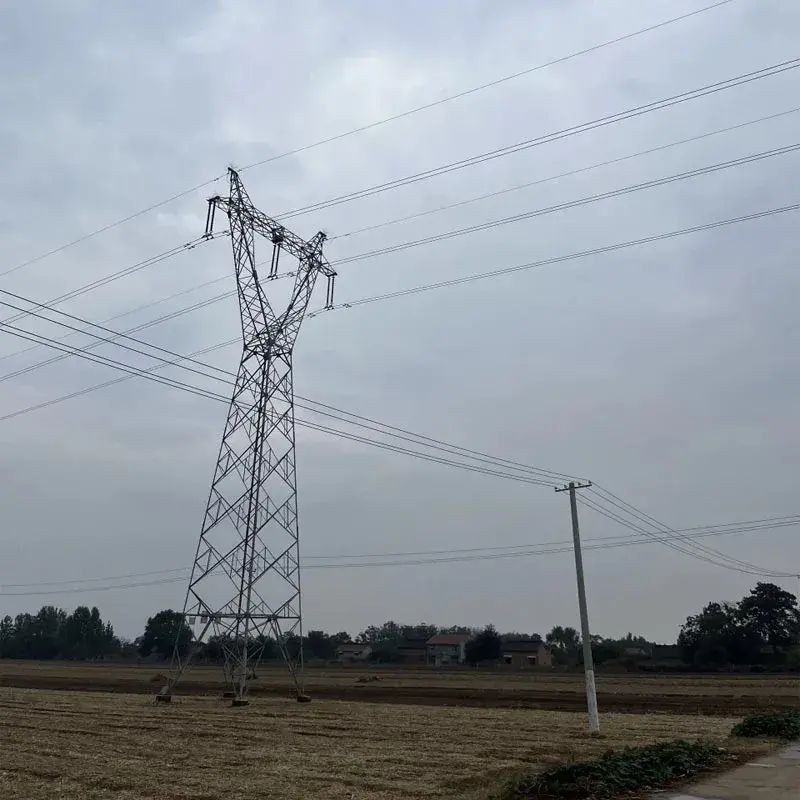
Walk beneath a high-voltage line and you'll notice something odd: the wires aren't always in the same spot. One moment the topmost cable hangs to the left, and a few towers down it's suddenly on the right. This isn't sloppy engineering—it's a deliberate dance called transposition, and it's what keeps the grid from frying itself. Without it, the invisible magnetic fields around each phase would play favorites, building unbalanced voltages that can overheat generators and mess with sensitive electronics miles away.
The technique is deceptively simple. Instead of running each phase in a straight line for hundreds of kilometers, engineers periodically swap their positions on the tower. By the time the power reaches your neighborhood, every phase has spent an equal distance in each physical position, evening out the electrical stress. It's a bit like rotating the tires on your car—spreading the wear so no single conductor bears the brunt of the line's own electrical personality. The towers themselves become more than steel skeletons; they're the stage for a precise ballet that balances the grid's bad manners.
But here's the kicker: transposition isn't just about symmetry on paper. In the real world, where terrain dips and winds howl, those swapped wires also reduce radio interference and slay the voltage gradients that can induce dangerous currents in nearby pipelines or fences. Next time you spot those odd-looking towers where the conductors cross over each other, you're seeing a decades-old trick that still outsmarts the chaos lurking in every megawatt.
From Blueprint to Skyline: The Evolution of China’s Tower Designs
China’s skyline has undergone a dramatic transformation over the past few decades, evolving from utilitarian blocks to futuristic icons. The earliest high-rises were heavily influenced by Soviet architecture, emphasizing function over form, with stark, repetitive facades. As the economy opened up, design philosophies shifted, blending global trends with local context. The 1990s saw a surge of postmodern towers in cities like Shanghai, where architects experimented with crowns, setbacks, and ornamental tops, often referencing traditional pagoda forms. This period laid the groundwork for a more expressive urban identity, breaking away from the homogeneity of earlier decades.
The new millennium brought an era of structural daring, as engineers and architects pushed vertical limits with super-tall landmarks. The Canton Tower’s twisted hyperboloid structure and the Shanghai Tower’s spiraling glass facade exemplify parametric design and aerodynamic innovation. These buildings are not merely taller; they integrate sustainability with double-skin facades, sky gardens, and wind turbines, responding to environmental challenges. The race for height is now balanced with a commitment to resilience and energy efficiency, marking a departure from pure spectacle toward intelligent, context-sensitive forms.
Today, China’s tower designs reflect a mature fusion of technology, culture, and human-centric planning. Architects draw inspiration from local landscapes, calligraphy, or mythical motifs, creating silhouettes that resonate with regional identity. The emphasis has shifted to vertical communities, where mixed-use programs combine offices, residences, and public spaces within a single edifice. Smart technologies enable responsive environments, while pedestrian-friendly podiums and elevated parks weave these giants into the urban fabric. The blueprint-to-skyline journey reveals an architecture that is increasingly self-assured, shaping not only city profiles but also the everyday experience of millions.
Inside the Material Science That Defies Extreme Conditions
Most materials crumble when pushed to their limits—extreme heat softens steel, frigid cold makes plastics brittle, and intense pressure can crush even the strongest alloys. But a handful of engineered substances laugh in the face of these harsh environments. Scientists have learned to manipulate atomic structures, creating ceramics that stay stable at temperatures hot enough to melt rock, and polymers that remain flexible in the vacuum of space. It’s not just about strength; it’s about designing materials that can be baked, frozen, or irradiated and still perform exactly as needed.
The secret often lies in the tiniest details. Take ultra-high-temperature ceramics, for example. They're crafted from compounds like hafnium carbide, which has a melting point above 3,900°C. At that level, the bonds between atoms are so tenacious that they barely vibrate apart. On the other end of the spectrum, alloys used in deep-sea exploration are engineered to resist the relentless squeeze of abyssal pressures, where a single flaw can lead to catastrophic collapse. These aren’t just incremental tweaks to existing formulas—they are radical reimaginings of how atoms ought to be arranged.
Bringing these wonders from the lab to the real world is a marathon of trial and error. Researchers push candidate materials through cycles of thermal shock, pressure spikes, and corrosive baths, hunting for the one composition that refuses to fail. Sometimes they discover that a material’s quirks—like a ceramic that actually gets tougher when cracked—become its greatest asset. The goal isn’t just survival; it’s creating materials that enable new technologies, from hypersonic flight to compact fusion reactors, where ordinary substances would be vaporized in an instant.
Engineering Without Borders: Global Influence of China’s Innovations
China's engineering footprint extends far beyond its borders, quietly reshaping landscapes from Southeast Asia to Africa. High-speed railways slice through mountains in Laos, modern ports deepen trade routes in Sri Lanka, and renewable energy projects illuminate remote villages in Kenya. These ventures aren't just construction projects; they're threads in a global fabric, weaving together local resources with Chinese technical prowess. The Belt and Road Initiative may grab headlines, but the real story unfolds in places like Ethiopia, where an industrial park has drawn textile factories and thousands of jobs, or in Bolivia, where a satellite launch expanded communication access for millions.
What sets China's approach apart is its blend of speed, adaptability, and a development-first mindset. Teams often work in challenging environments, learning to navigate local regulations, cultural nuances, and extreme climates. In Pakistan, engineers adjusted tunneling methods to suit the Himalayas, while in Nigeria, railway designers adapted to urban sprawl without displacing communities. These adjustments aren't always publicized, but they reveal a pragmatic problem-solving style. Partnerships with local contractors and governments have built a network of allies, fostering skills transfer that outlasts the bulldozers.
The global influence of these innovations goes beyond physical infrastructure. Standards for construction, renewable energy grids, and digital payment systems are slowly aligning with Chinese models, setting precedents for future projects worldwide. At the same time, the influx of Chinese technology has sparked new industries, from smartphone assembly in India to electric vehicle production in Thailand. This quiet integration into daily life—through bridges, base stations, and satellite data—often escapes notice, but it's steadily redefining how developing nations connect and grow.
Future Horizons: Next-Gen Concepts Inspired by Classic Designs
There's a quiet power in designs that refuse to age. They don't just survive decades — they shape the decades ahead. The crisp geometry of a mid-century chair, the satisfying click of a rotary dial, the simplicity of a well-bound book: these aren't relics. They're blueprints. When you strip away the noise, what's left is a core idea so solid that every new generation of creators can't help but build on it. The future isn't a rejection of the past; it's a conversation with it.
Take something as mundane as the pocket watch. It told time with quiet elegance, then evolved into the wristwatch, which morphed into the smartwatch. Yet the smartwatch still borrows its soul — that circular face, that tactile crown — from its ancestor. This isn't nostalgia. It's recognition that some forms simply work, and that human intuition clings to the familiar even as technology leaps forward. Designers today are mining similar veins: reviving the physical dials and switches in cars as touchscreens lose their novelty, or reprising the warmth of wood and wool in smart homes that risk feeling sterile.
Looking ahead, the most compelling innovations will be those that feel both inevitable and surprising — a synthesis of heritage and horizon. Electric vehicles with the stance of vintage roadsters. Digital interfaces that mimic the texture of aged paper. Wearables that echo the craftsmanship of a bespoke tailor. The aim isn't to imitate, but to translate enduring principles — proportion, tactility, honesty of materials — into a language that speaks to tomorrow. In that space between reverence and reinvention, the next generation of icons is being born.
FAQ
These towers are a fascinating blend of ingenious design and brute strength. Unlike conventional pylons, their lattice structure allows them to gracefully handle the complex task of phase transposition, all while withstanding extreme weather and seismic activity. They’re not just functional—they’re a statement of how far structural engineering can go when you refuse to cut corners.
Phase transposition is all about balancing impedance across conductors to minimize losses and interference. These towers achieve it through a clever arrangement of crossarms and insulators, literally twisting the conductor positions at specific intervals. It’s a low-tech yet highly reliable method that avoids the need for additional substations, keeping the transmission smooth over hundreds of kilometers.
Angle steel hits that sweet spot between cost, weight, and strength. It’s incredibly easy to bolt together on site—no heavy welding needed—and its open shape sheds wind load efficiently. Plus, the galvanization gives it decades of rust-free life even in harsh climates. Solid tubular steel or concrete just can’t match that combination of practicality and resilience.
Lattice towers are like skeletons: they use far less material while achieving the same height and load-bearing capacity. The open framework drastically reduces wind resistance, which is critical in typhoon-prone regions. They’re also modular, meaning damaged sections can be replaced without dismantling the whole structure. It’s the ultimate example of 'less is more' in structural engineering.
You’ll find them carving their way through the tiger-leap gorges of the Yangtze tributaries, or straddling the misty karst peaks of Guizhou. Some soar above the terraced rice fields of Yunnan, while others march determinedly across the Gobi Desert. Each line reads like a cross-country adventure story, navigating terrain that would give any civil engineer a run for their money.
They’re built to shrug off glacial ices storms that can coat the steel in inches of ice, sudden typhoon winds screaming at over 200 km/h, and even magnitude 8 earthquakes. The lattice structure absorbs shocks like a collapsible cage, distributing stress so nothing snaps. In alpine areas, they handle wild temperature swings from -40°C to blazing sun, all without a single complaint.
First, the site is accessed by building rudimentary mountain roads—sometimes with helicopters ferrying in the steel. Workers bolt together pre-cut angle steel pieces, climbing up the rising framework with nothing but harnesses and nerves. A single tower might use over 1,500 bolts, each tensioned to exact specs. The final step is lifting the immense insulator strings into place, often hand-guided with millimeter precision.
They embody a stubborn commitment to connecting the far-flung corners of the country, no matter the geographical hurdles. There’s a near-poetic symmetry in using such intricate, exposed structures to silently weave the grid together. It’s not just about moving power—it’s about threading civilization through some of the planet’s most uncompromising landscapes with a design that respects both nature’s fury and quiet beauty.
Conclusion
Angle steel lattice transposition towers stand as a testament to China's mastery of high-voltage power line engineering, blending structural ingenuity with practical necessity. At their core, these towers embody a brilliant synthesis of lightweight yet robust design—the open lattice framework, forged from high-strength angle steel, disperses wind loads and resists buckling even under extreme typhoons or icy conditions. The transposition function itself is an artful solution to electromagnetic imbalances: by elegantly rotating conductor phases at carefully calculated intervals, these towers tame power line chaos, slashing inductive interference and boosting transmission efficiency across vast distances. Their evolution from early Soviet-inspired blueprints to today's digitally optimized, modular configurations mirrors China's rapid infrastructure ascent, each generation refining material science with corrosion-resistant alloys and hot-dip galvanizing that laughs off decades of harsh climates.
Beyond their borders, China's innovations in tower design have quietly reshaped global standards, with variants now anchoring grids from Southeast Asia to Africa—adaptable, economical, and built to endure. The lattice transposition tower is far from static; researchers are already exploring hybrid composites and self-diagnosing smart structures that honor classic geometries while pushing into future horizons. It's this seamless fusion of time-tested principles and forward-looking ambition that cements these unassuming steel giants as true engineering marvels, silently powering modern life from horizon to horizon.
Contact Us
Contact Person: antor khan
Email: [email protected]
Tel/WhatsApp: 8613863903569
Website: https://www.qdabtower.com/