

Best tFUS Transducer for Non-Invasive Brain Stimulation
2026-08-28
Finding a transducer that delivers consistent, safe neuromodulation without compromising on spatial resolution is tougher than it sounds. Most tFUS setups fall short in one area or another, leaving researchers frustrated. Siansonic has been working to change that. In this guide, we break down what actually matters when selecting a tFUS transducer—and why the latest Siansonic models are getting noticed in non-invasive brain stimulation labs.
Piezoelectric Composites Aren't the Only Option Anymore
For a long time, specifying a piezoelectric composite felt like the safe choice. Blend PZT fibers into an epoxy, tune the volume fraction, and you get a transducer that works. But that convenience came with tradeoffs: brittle phases, lead content, and a ceiling on strain before performance dropped. Those tradeoffs are no longer unavoidable. Relaxor single crystals such as PMN-PT now produce charge coefficients several times higher than typical composites, while thin-film aluminum nitride and scandium-doped aluminum nitride bring piezoelectric response into MEMS-scale devices that a composite could never fit.
What has changed is the breadth of alternatives. Potassium sodium niobate and other lead-free ceramics have moved out of the lab and into commercial actuators and sensors, offering compliance without the environmental baggage. Polymer-only approaches, including porous ferroelectrets and triboelectric layers, handle bending, stretching, and impact in ways a rigid composite would fail after a few cycles. This wider menu means a design team can start from the actual mechanical and electrical requirements instead of forcing every problem into a fiber-reinforced piezoelectric sheet.
Frequency Choice: The Real Tradeoff Between Focus Size and Skull Penetration
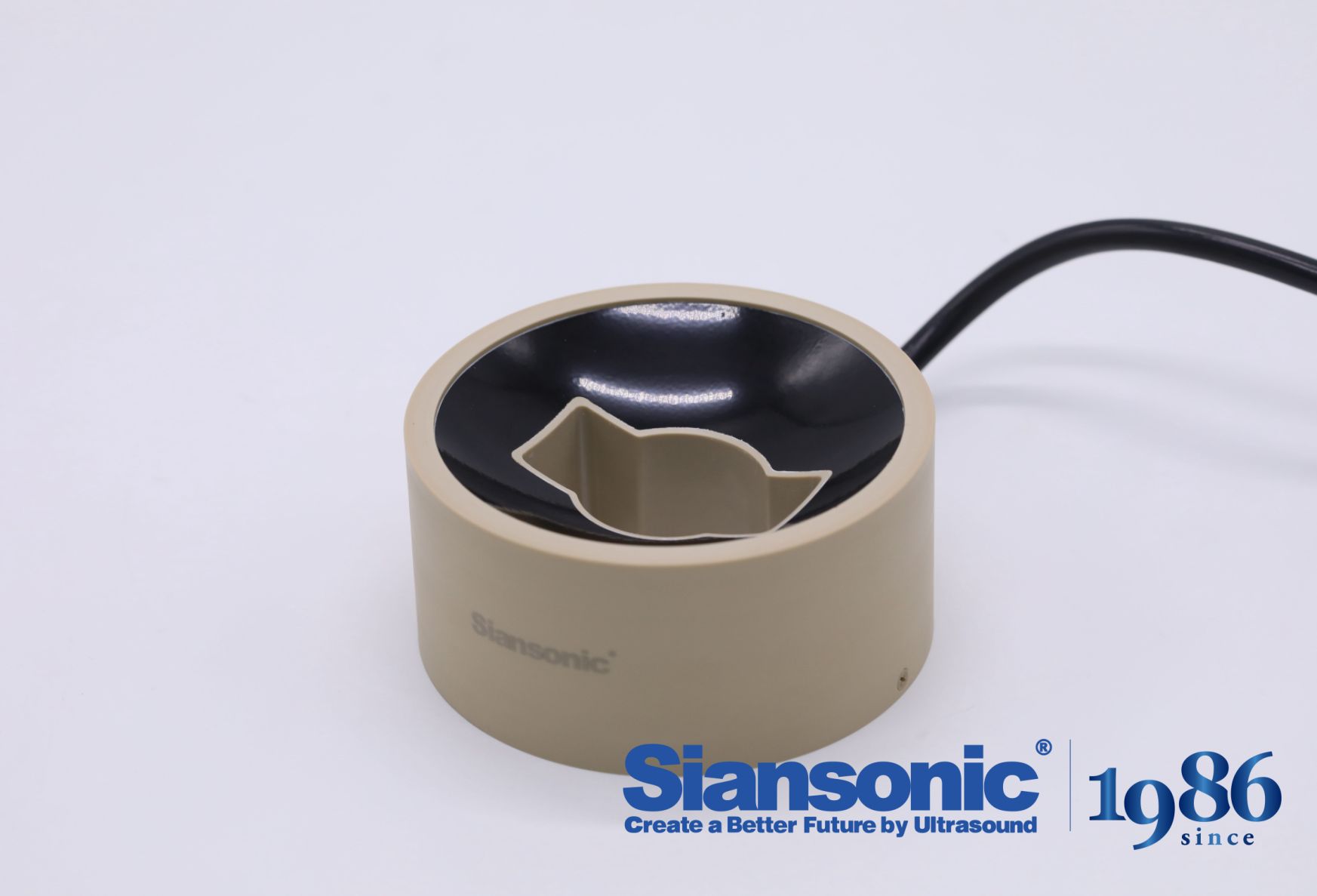
At first glance, picking an ultrasound frequency seems like a straightforward compromise: lower frequencies push through bone more easily, while higher frequencies create a tighter focal spot. But the practical tradeoff runs deeper. Skull bone behaves as a selective filter, allowing longer wavelengths to pass with less attenuation and scatter, while shorter wavelengths get absorbed or deflected. A transducer operating at 250 kHz or 500 kHz can often reach deep targets through the temporal window, yet the resulting focus may span several millimeters. That broad volume can be acceptable when the goal is neuromodulation across a wider region, but it leaves little room for precise spatial control.
Raising the frequency to 1 MHz or above shrinks the focus to sub-millimeter dimensions, which sounds ideal for targeted treatment. The penalty shows up at the skull. Higher frequencies deposit more heat in the bone, suffer greater phase distortion from variable bone thickness, and can misplace or blur the focus without patient-specific correction. So the decision hinges on the target location and the acceptable skull burden. For shallow cortical areas, a higher frequency may justify the added complexity. For deeper structures or thicker skulls, a lower frequency often wins even though the focal region becomes larger.
Phased Arrays vs. Single-Element Transducers: A Field-Tested Comparison
In routine field work, single-element transducers have been the baseline for decades—they're simple, rugged, and predictable when you're scanning welds or checking for wall loss. The operator relies on a fixed angle and a known focal point, so interpretation is straightforward, but coverage is confined to that one beam path. If the flaw isn't oriented favorably, you either miss it or spend extra time re-scanning with different wedges.
Phased arrays change that logic by letting you steer and focus the beam electronically. On a recent pipeline girth weld inspection, we swept through a range of angles without swapping probes, and the sector scan highlighted a lack of fusion that a conventional 45-degree single-element unit would have only hinted at. The trade-off is setup time and the learning curve: calibrating delay laws, verifying element activity, and keeping the array clean demands more attention than just plugging in a single crystal.
For quick verifications or simple geometries, I still reach for a single-element transducer because it's lighter, cheaper, and there's less to go wrong. But when access is tight or the geometry is complex, a phased array probe earns its place by cutting scan time and giving a more complete picture. Ultimately, it's not one versus the other—it's about matching the tool to the actual job conditions rather than defaulting to habit.
Why Matching and Backing Layers Make or Break a tFUS Build
In a tFUS transducer stack, the matching layer sits between the piezoelectric element and the skull, and its acoustic impedance determines how much of the generated pressure wave actually crosses the boundary. Without a properly tuned matching layer, a large fraction of the acoustic energy reflects back into the transducer, reducing transmission efficiency and heating the device instead of delivering energy to the brain. A quarter-wavelength layer with impedance close to the geometric mean of the piezoelectric ceramic and tissue/bone can drop insertion loss dramatically, but the exact material and thickness vary with operating frequency—usually 0.5–1 MHz for transcranial applications—and the curvature of the element.
Backing layers are just as decisive. They damp the ringing of the piezoelectric element after the excitation pulse, shortening the emitted burst and improving axial resolution. But in tFUS, you also want to preserve enough output pressure for deep brain targets, so the backing cannot be too lossy. A heavy, highly attenuative backing will kill reverberations, yet it also absorbs a good chunk of the forward-directed acoustic power, forcing higher drive voltages and increasing thermal load. Designers often settle for a moderately attenuative backing with an impedance that balances ring-down time against pulse amplitude, sometimes adding a tuned matching network on the electrical side to recover some of the lost bandwidth.
The interplay between matching and backing layers starts to dominate when you move from benchtop transducers to skull-phased arrays. Small mismatches in layer thickness or material homogeneity across dozens or hundreds of elements create phase errors that blur the focus and shift the acoustic hotspot. In practice, a build with excellent piezoelectric material but poorly controlled matching/backing layers will underperform a cheaper array with tighter layer tolerances. That is why fabricators measure impedance profiles on every element and reject batches where the layer-to-layer variability exceeds a few percent.
Acoustic Lenses and Holograms: Cheaper Precision Without Complex Electronics
Traditional high-precision acoustic beamforming leans on arrays of individually driven transducers, each needing its own amplifier and timing circuitry. Acoustic lenses flip that model. By shaping a material whose speed of sound differs from the surrounding medium, you can focus or collimate sound waves much like a glass lens bends light. A single transducer paired with a carefully designed lens can produce a sharp focal spot that would otherwise require dozens of electronic channels. The lens does the wavefront shaping passively, cutting bill of materials and assembly time while retaining excellent spatial resolution.
Acoustic holograms take this idea further. Instead of a simple lens profile, a computer-generated phase mask is printed or machined into a thin plate. Every point on that plate imposes a specific phase delay on the passing sound, reconstructing an arbitrary target field on the other side. This means you can create multi-focal patterns, shaped beams, or even complex acoustic images without any per-element electronics. Because the hologram is a single passive component, it can be manufactured cheaply and swapped out for different applications—essentially turning a fixed transducer into a reconfigurable precision instrument.
The practical payoff shows up across fields. Medical ultrasound probes can become less expensive and easier to sterilize when much of the beamforming is handled by a replaceable lens or hologram. Industrial nondestructive testing benefits from simpler fixtures that still generate the required focused or angled beams. Even consumer audio can use these elements to steer sound more precisely without adding amplifiers and DSP channels. By moving precision from electronics into geometry, acoustic lenses and holograms deliver a level of control that used to demand complex, costly hardware.
Validating Transducer Performance Beyond Water Tank Measurements
Water tank measurements remain the standard starting point, but they impose a flat, still, and thermally stable environment that rarely matches actual service. Once a transducer is mounted in a housing, exposed to pressure cycles, or driven through a long cable, its resonance and directivity can shift enough to invalidate assumptions carried over from the tank.
A practical alternative is to treat tank data as a reference rather than a verdict. Field comparisons, impedance sweeps after installation, and short burst responses under real loading give a clearer picture of how the element behaves when it matters. For units deployed in moving water or variable temperature layers, those differences often show up first as a widening bandwidth or a small drop in transmit sensitivity.
Recording the test setup in detail—drive level, ambient temperature, cable length, and any acoustic shielding—makes repeat tests far more useful. Over time, this builds a performance fingerprint for each transducer, so drift or early damage can be spotted before it becomes a field failure.
FAQ
A good transducer balances high acoustic output with precise focal control. It should deliver enough energy to modulate neural activity without excessive heating or cavitation, and its geometry needs to match the intended depth and size of the target region. Efficient electrical-to-acoustic conversion also reduces power demands and improves repeatability across sessions.
Lower frequencies around 0.5 MHz penetrate deeper but produce a larger focal volume, which can be a problem for small nuclei. Higher frequencies above 1 MHz give tighter focus but lose energy faster through the skull. The transducer frequency must be matched to the depth of the target, with many research groups settling between 0.5 and 1.0 MHz for a workable compromise.
Piezoelectric composites like 1-3 connectivity PZT-polymer are preferred over solid ceramics because they have broader bandwidth and lower acoustic impedance. This improves coupling to tissue and reduces ringing. Matching layers and backing materials also need careful design to avoid overheating and to keep the emitted waveform clean for neuromodulation.
The lens or spherical curvature determines the distance from the transducer face to the natural focus. A well-designed lens corrects for skull-induced phase aberrations and reduces side lobes that could stimulate unintended areas. Some newer transducers use patient-specific holographic lenses based on CT scans to correct for individual skull geometry.
Rarely. A transducer with a fixed focal length can only reach a narrow depth range with high precision. To hit both superficial cortex and deeper structures like the thalamus or hippocampus, you typically need interchangeable lenses, a phased-array design with electronic depth steering, or multiple transducers with different radii of curvature.
Phased-array transducers with many independent elements allow electronic steering of the focus without physically moving the transducer. This is essential for protocols that need to target different brain regions in the same session or correct for subject movement. The trade-off is higher cost, more complex driving electronics, and increased thermal management requirements.
Built-in temperature sensors near the transducer face help prevent skin burns during long stimulation trains. The housing should be lightweight, watertight, and compatible with degassed water coupling. Real-time cavitation detection, either through passive acoustic mapping or integrated hydrophones, is also important to avoid unwanted mechanical damage to tissue.
Accurate targeting is impossible without knowing where the focus lands in the brain. Transducers that come with or easily attach to optical tracking markers and have registration software for MRI or CT scans reduce setup time and improve reproducibility. This is especially relevant for clinical studies where off-target stimulation could confound results or pose a safety risk.
Conclusion
The search for the best tFUS transducer rarely ends with a single part number, because the right choice depends on how you weigh skull losses against focal precision. Piezoelectric composites used to dominate conversations, but they are no longer the only route—single-crystal piezoelectrics and capacitive micromachined designs can offer broader bandwidth or easier array integration, even if they bring their own fabrication headaches. Frequency selection sits right at the center of this trade. Lower frequencies around 250–500 kHz survive the skull with less attenuation and heating, yet the focal spot grows larger; pushing toward 1 MHz or beyond tightens the focus but demands more acoustic power to overcome bone. Phased arrays add steering and the ability to correct for skull aberrations, but they multiply channel counts, cost, and tuning effort. A well-built single-element transducer with an acoustic lens can often outperform a mediocre array when the target is static and shallow.
Matching and backing layers often get overlooked but decide how much energy actually reaches tissue and how quickly the device stops ringing after each pulse. A poorly matched front face wastes pressure at the skin, while a lossy backing shortens the pulse at the price of output. Acoustic lenses and holographic phase plates are the practical middle ground: they reshape the beam or create multi-focal patterns without complex electronics, making precision cheaper for fixed targets. Finally, any “best” label has to survive validation beyond a water tank. Skull phantoms, ex vivo bone, thermal imaging, and in situ hydrophone scans reveal reflection, standing waves, and heating that clean water measurements hide. The strongest tFUS builds are not defined by one headline spec; they balance material, frequency, aperture, lens design, and careful testing around the intended brain target.
Contact Us
Contact Person: Ivy Zhang
Email: [email protected]
Tel/WhatsApp: +86 1081502288
Website: https://www.siansonic.com/