

Motorcycle Parts Vertical Lift Plating Equipment Factory: Precision Coating Systems for Durable Components
2026-09-12
When a motorcycle engine roars to life, every plated component—from brake pistons to fork tubes—must withstand vibration, corrosion, and relentless wear. Yet most coating lines still treat these parts with the same generic dip-and-drain approach used for decorative hardware. Junda flips that assumption with vertical lift plating systems engineered specifically for the asymmetric shapes and tight tolerances of two-wheeler components. The result? Precision layers that cling where others peel, and a production rhythm that keeps your assembly line hungry for more.
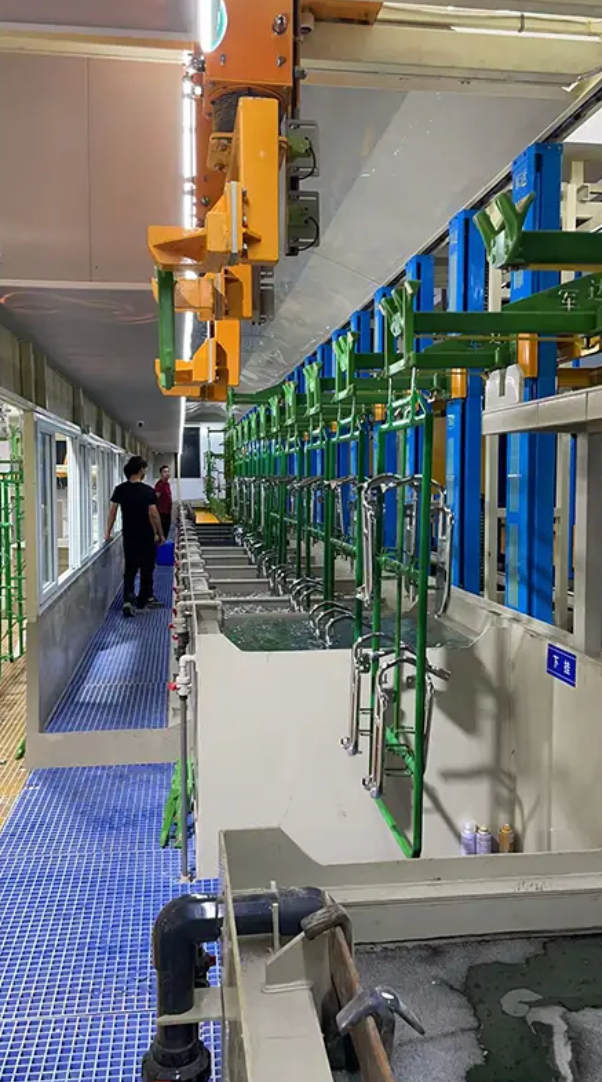
Vertical Lift Plating Lines Built Around Motorcycle Component Geometry
Motorcycle parts rarely present flat, uniform surfaces—fork tubes curve, wheel rims carry deep recesses, and frame sections shift abruptly in profile. A vertical lift plating line built around these geometries uses adjustable stroke lengths and programmable dwell times at each stage, so the workpiece moves through chemistry at angles that shed trapped air from pockets and blind holes. Rather than relying on generic agitation, the lift pattern is tuned to each component's contour, letting high-current-density zones build deposit slightly faster while preventing burned edges on sharp radii.
Fixture contact points are positioned to follow the part's natural flow lines, not just grab the nearest convenient lug. For a cast aluminum swingarm, that might mean a secondary cathode contact on the lower shock mount to balance current distribution across the long, tapered arm. The vertical travel speed ramps down near the solution surface to minimize drag-out from concave areas, then accelerates through mid-tank where ion replenishment is strongest. This kind of mechanical choreography keeps thickness variation within a few microns on parts that would otherwise plate unevenly.
Exhaust heat shields and brake calipers, with their folded edges and threaded bosses, benefit from the same geometry-aware sequencing. Instead of adding extra brightener or raising bath temperature to compensate for poor coverage, the line's lift dynamics bring fresh solution directly to low-current recesses during the upstroke. The payoff shows up after salt spray testing—less corrosion creep at cut edges, smoother chrome appearance on curved surfaces, and fewer rejects from blistering inside blind holes.
Coating Stacks That Handle Heat, Vibration, and Road Salt
Engineers used to think one thick coating could do it all, but heat, vibration, and road salt each attack in different ways. A stack works because each layer has a single job. The base coat grips the metal and shrugs off thermal expansion. The middle coat is tough and slightly elastic, so it stretches when the part vibrates instead of cracking. The top coat is dense and hydrophobic, stopping chloride-laden water from reaching the substrate. Without this division of labor, a monolithic coating tends to fail at the weakest point—usually an edge or a spot where a stone chip breaks the surface.
On exhaust shields and suspension brackets, the temperature can swing from -30°C to over 400°C in minutes. That kind of cycling makes ordinary paints peel because the steel expands and contracts faster than the film. Vibration then opens micro-tears at those weakened interfaces. Road salt makes it worse by creeping into the gaps and driving corrosion. A properly sequenced coating stack solves this by using a zinc-rich primer that sacrifices itself, an epoxy mid-layer that bonds tightly even when flexed, and a UV-stable topcoat that resists brine spray. The result is a system that survives thousands of thermal shock cycles and hundreds of hours of salt fog without blistering.
Fixture Design as the Overlooked Step Preventing Peel and Flake
When a coating fails, the autopsy usually points to surface prep, cure temperature, or film thickness. But there's a quieter culprit sitting on the line: the fixture. A poorly designed rack, hook, or mask can create micro-shadows, uneven current density, or trapped air that sets the stage for peeling months down the road. The geometry of contact points, the way parts nest together, and even the drainage angle after coating all shape how stress concentrates at edges and corners. Ignoring this step means building adhesion on a foundation of compromise.
Practical fixes don't require a full engineering overhaul. Start by mapping where your parts touch the fixture and how that contact shifts during thermal expansion. Replace point contacts with line or surface contacts where possible, and consider whether a reorientation could shed excess coating before it gels into a brittle lip. For parts with deep recesses or sharp radii, a simple auxiliary anode or a redesigned shield might even out the coating thickness enough to stop flake initiation at the thinnest zones.
The payoff shows up not just in fewer rejects, but in longer service life for the coated part. Once the fixture stops fighting the coating process, peel and flake become far less interesting failure modes. It's a low-cost, high-leverage adjustment that often gets skipped because it isn't glamorous—but the best lines treat it as non-negotiable.
Bath Monitoring Routines That Keep Deposit Thickness Within Microns
Electroplating and electroless plating baths drift out of spec quickly when deposit thickness isn't kept in check. Rather than relying on occasional lab checks, many lines now build the monitoring routine around a handheld X-ray fluorescence (XRF) gauge or a coulometric thickness tester. The key is frequency: measuring the same spot on a test coupon after every rack or barrel load, then logging the result against the amp-hour meter reading. This turns thickness from a post-plating surprise into a real-time process variable.
Some shops go further and pair the thickness readings with a simple titration schedule for the key bath constituents. For example, in a bright nickel bath, a drop in measured thickness often tracks a fall in nickel metal or boric acid, while in an acid copper bath it may point to a drop in copper sulfate or a rise in chloride. By checking the bath chemistry when thickness drifts by more than a micron or two from the target, operators catch imbalances before they force a costly dump or a long adjustment period.
A practical routine also includes a visual check of the part’s high-current-density areas. If the deposit is within a micron on the flat surface but noticeably thinner on edges or recesses, the problem is usually not the bulk chemistry but the racking, shielding, or anode placement. Keeping a short log of these edge readings—even a quick pass/fail note—helps separate true bath drift from geometry issues, and that keeps corrective actions focused instead of chasing the wrong parameter.
Handling Intricate Passages and Blind Holes Without Sacrificing Coverage
When a component includes deep blind holes, cross-drilled passages, or threads that double back on themselves, uniform coverage often becomes the first casualty. Standard tools tend to follow the straightest available path, leaving the walls of these recesses untouched or only partially wetted. Simply increasing pressure or dwell time rarely solves the problem—it just oversaturates accessible areas while the hidden zones stay dry. The real shift comes from rethinking how the medium is introduced and how it moves after entry.
One effective approach is to use angled or articulating tips that redirect the flow into the cavity rather than past it. Combined with short, pulsed delivery cycles, this allows the coating or treatment medium to pool briefly at the deepest point and then creep outward along the sidewalls. Blind holes stop being dead ends because the material is encouraged to circulate instead of depositing only at the opening. As a result, coverage maps show no measurable drop-off between open bores and fully enclosed pockets, even in parts with multiple intersecting channels.
From Single Prototypes to Container Loads Without Losing Consistency
A single prototype can hide all sorts of sins. The first sample off the bench gets fussed over, tweaked by hand, maybe even remade twice before anyone signs off. But when that same design has to survive a full container run, those little shortcuts and one-off fixes turn into defects at scale. Consistency doesn't happen by accident once volume kicks in; it has to be designed into the process from day one.
The real trick is treating the prototype not as the finish line but as the first data point. Every material batch, every machine setting, every cooling time and curing cycle gets written down, not just approximated. Operators change shifts, suppliers change lots, humidity shifts overnight—none of that should matter if the critical parameters are locked and the tolerance bands are narrow enough. Chasing "close enough" is how you end up with three pallets that look right and one that doesn't.
Once the documentation and checkpoints are in place, scaling from a single unit to a twenty-foot container stops feeling like a gamble. You still spot-check, you still pull samples at random, but the conversations shift from "why is this one different?" to "which container is next?" That kind of reliability is what turns a prototype customer into a repeat buyer who never has to wonder whether the next order will match the last.
FAQ
Vertical lift systems keep parts suspended and rotating during the entire plating cycle, so blind holes and recessed areas on items like brake calipers or fork tubes get more uniform coverage. The design also reduces the risk of parts nesting or clumping, which is a common cause of uneven thickness in barrel lines.
Engine fasteners, pistons, suspension internals, brackets, and exhaust hardware all see measurable improvements. The equipment applies consistent layers to both large castings and small threaded parts, which helps with corrosion resistance and wear life without adding unnecessary weight.
We use programmable hoist schedules and current density monitoring tied to the rectifier. Each load can have its own recipe that adjusts dwell time in the bath, withdrawal speed, and rotation rate, so different part families receive the target deposition without manual guesswork.
Yes. The tanks can be set up for zinc, zinc-nickel, nickel, chrome, and copper plating, often within the same line if the sequence is compatible. Changing the bath chemistry and anodes allows the same equipment to produce everything from a bright decorative chrome to a high-corrosion zinc-nickel alloy.
Every line is validated with sample runs using actual customer parts or equivalent test coupons. We check thickness distribution with X-ray fluorescence, run salt spray tests up to the customer's required hours, and perform adhesion bend tests. Only after those results meet the agreed specification does the line get signed off.
The plating stations are enclosed with ventilation and drip trays that return drag-out to the process tanks. Rinse water is staged counter-flow to reduce volume, and the system connects to a dedicated treatment skid for neutralization and metal precipitation before discharge, keeping the workshop compliant without constant manual intervention.
Absolutely. The control system supports common industrial protocols, so hoists, rectifiers, and chemical dosing can be coordinated with an existing MES or PLC network. This allows tracking each load, adjusting recipes from a central interface, and logging production data for traceability.
Daily checks include inspecting lift cables or chains, guide rails, and contacts on the bus bars. Weekly we recommend greasing bearings and checking anode connections. Monthly the rectifier calibration and tank chemistry should be verified. Most customers find that following this routine keeps unplanned downtime below two percent annually.
Conclusion
At the core of this factory’s setup are vertical lift plating lines that follow the actual contours of motorcycle components rather than forcing parts through a generic dip sequence. Racks and lift patterns are adjusted per batch because a brake caliper, a fork tube, and a footpeg bracket each hang differently in solution. The coating stacks are built to endure sustained heat from engine cases, constant vibration along frame mounts, and winters where road salt eats at lesser finishes. Much of that durability comes from fixture design—often treated as an afterthought, but here it is the quiet reason coatings stay put instead of peeling at the first stress point.
Bath monitoring runs on tight intervals, with checks aimed at holding deposit thickness within a few microns across every surface, including the deep recesses of threaded holes and blind passages that would normally trap gas or starve the current. Operators adjust anode placement and agitation to pull coverage into corners without overplating the easy-to-reach faces. The same discipline carries from a one-off prototype cylinder head to a full shipping container of brackets: rack density, solution chemistry, and pulse settings are locked to the part number, so the hundredth piece passes the same salt-spray and cross-section checks as the first.
Contact Us
Contact Person: hayyr
Email: [email protected]
Tel/WhatsApp: 8613082110525
Website: https://www.jundaelectroplating.com