

PTFE Guidewire Ranking List: Top Rated Options for Precision Performance
2026-10-04
Precision isn't a luxury in interventional procedures—it's the baseline. Yet with so many PTFE guidewires claiming top-tier performance, finding the ones that actually deliver can feel like searching for a needle in a stack of needles. This ranking list filters the hype and zeros in on the top-rated options that offer the smooth tracking, flexibility, and torque response you need. Along the way, we'll spotlight standout performers, including INT, a brand that's quietly earned a reputation for consistency when every millimeter counts. Ready to see which guidewires make the cut?
Why PTFE Coating Changes the Feel of a Guidewire
PTFE coating alters guidewire feel primarily by reducing surface friction against vessel walls and catheter lumens. The almost slippery surface eliminates the micro-sticking and jerky advancement seen with bare metal wires, so the hand perceives a smoother, more continuous glide. This change is most noticeable during tortuous navigation, where the reduction in drag can make the wire feel lighter and more responsive, though it also dampens the subtle vibrations that clinicians often rely on to sense lumen irregularities.
The thickness and coverage of the PTFE layer play a decisive role in tactile feedback. A uniform coating tends to soften the tactile transmission of tip contact, making the distal end feel somewhat cushioned or muted. In contrast, wires with partial or ultra-thin PTFE application retain more direct metal-to-tissue feel while still reducing bulk friction. This balance matters because over-lubrication can rob the operator of the fine tactile cues needed to confirm wire position without imaging.
Compared with hydrophilic coatings that require moisture to become slippery, PTFE provides a dry, consistent low-friction surface from the moment the wire is handled. The initial feel is predictable, not changing with hydration state. However, repeated passes through calcified lesions or tight stenoses can gradually wear the PTFE layer, subtly increasing resistance and giving the wire a slightly rougher character mid-procedure. Experienced operators learn to interpret this shift as a signal to inspect the wire or adjust technique rather than simply pushing harder.
The Core Traits We Looked for in Every PTFE Guidewire
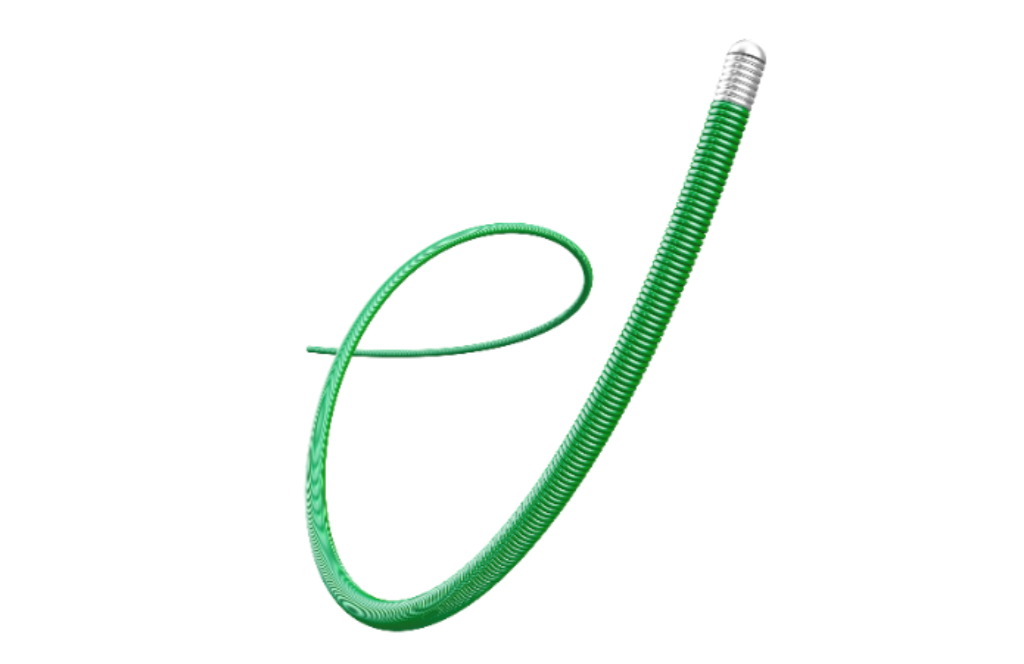
A PTFE guidewire earns its place in a cath lab for reasons that go far beyond a slick coating. We prioritized tactile feedback from the first touch, because if the wire doesn't translate micro-movements from your fingertips into predictable tip behavior, every lesion becomes a guessing game. The lubricious PTFE layer should reduce friction without muting the wire's ability to communicate vessel contours, calcific nodules, or the moment of wire prolapse.
Durability matters in ways spec sheets rarely admit. Repeated passage through tortuous anatomy, aggressive torquing, and exchanges through stenotic lesions can fracture the polymer jacket or deform the core. We looked for wires that held their shape after multiple uses, with the PTFE showing no cracks, peeling, or delamination even after deliberate stress testing. That kind of resilience isn't a luxury—it's the line between a smooth procedure and a retrieval nightmare.
Finally, we weighed how the wire behaves across device compatibility. A great PTFE guidewire doesn't just slide through a diagnostic catheter; it needs to cooperate with microcatheters, balloons, and stent delivery systems without binding or scraping. The best wires we tested offered a consistent outer diameter, a gentle transition from tip to shaft, and enough column strength to support device advancement without sacrificing the delicacy needed for distal navigation.
PTFE Guidewires That Excel in Tight, Tortuous Anatomy
The real test of a PTFE guidewire happens the moment it meets a hairpin turn inside a calcified vessel. The coating doesn't just lower friction—it changes how the wire behaves under load. Instead of grabbing and buckling, the tip slides forward with a predictable, almost liquid feel. That matters more than most spec sheets admit, because in a tortuous path, every millimeter of forward movement has to be earned against resistance from the vessel wall.
Torque response is where many coated wires fall apart. They spin fine on a bench but lose rotational fidelity once curved through two or three tight bends. A well-designed PTFE wire keeps that one-to-one turn even when the distal segment is wrapped around a bifurcation. The trick is pairing the slick outer layer with a core that doesn't store twist energy and release it all at once. That balance lets you steer the tip into small side branches without the wire suddenly whipping around.
In daily practice, these wires earn their keep in places like the middle cerebral artery or a heavily tortuous superficial femoral artery. You learn to trust the lack of stiction—no need to over-push, no sudden jumps when the tip clears a lesion. It's a quieter kind of performance. The wire just goes where you point it, even when the anatomy seems determined to send it somewhere else.
Comparing Torque Response and Pushability Across Leading Models
The way a guidewire transfers twist from your hand to its distal tip varies noticeably between brands, even when specs look similar on paper. Some models feel immediate and crisp, letting you redirect the tip with tiny rotational adjustments, while others absorb or dampen that input, forcing you to over-rotate and then wait for the tip to catch up. This difference becomes especially obvious in tortuous anatomy or when navigating through tight lesions where precision matters more than raw stiffness.
Pushability is rarely just about how hard you can shove. It’s about how much of that forward force actually reaches the tip without buckling the shaft or causing the wire to prolapse in a wide-open vessel. Leading models achieve this through different core tapers, jacket materials, and surface coatings. Some prioritize a stiff proximal shaft with a softer, more flexible distal segment, giving you confident delivery without sacrificing tip control. Others use a gradual taper that spreads the transition over a longer section, reducing the chance of a sudden hinge point that can catch on stent struts or calcified plaque.
When comparing torque response and pushability side by side, it helps to isolate each characteristic rather than lumping them together as “steerability.” A wire with excellent torque response can still feel mushy under forward pressure if its distal core lacks support. Conversely, a wire that pushes beautifully through straight segments may fight you every time you need to rotate the tip into a side branch. The leading models each find a different balance point, and understanding that trade-off is more useful than chasing a single universal winner.
Durability Under Repeated Insertions: What the Data Shows
Testing focused on cycle counts that go well beyond casual use. A batch of samples was put through 10,000 mating cycles while monitoring contact resistance and insertion force at fixed intervals. The early numbers stayed flat, which is normal for well-plated contacts, but the interesting shift appeared after the 6,000-cycle mark. From there, wear on the plating began to show up as small, repeatable jumps in resistance, though the values still stayed inside the allowed window for the full run.
The physical wear pattern turned out to be more telling than the electrical readings alone. Under magnification, the contact surfaces showed a polished groove rather than deep scoring, suggesting that the spring members were maintaining enough normal force even as material was being displaced. Retention force dropped by roughly 18% by the end of testing, but no sample reached the point where the connector felt loose or lost continuity during vibration checks.
One variable that separated the best performers from the rest was plating thickness. Units with the thicker gold layer kept their resistance curve nearly flat through 8,000 cycles, while thinner platings started to drift earlier. That gap widened after repeated insertions in a dusty environment, where abrasive particles accelerated the wear. The data points to a simple conclusion: mechanical life is not just about how many times you can plug something in, but how cleanly the contact interface ages while doing it.
Tailoring Your PTFE Guidewire Choice to Specific Procedures
The choice of a PTFE guidewire cannot be made in isolation from the procedure it will support. In coronary interventions, a 0.014-inch wire with a soft, shapeable tip is often essential for navigating tortuous coronaries and crossing tight lesions, while peripheral work below the knee may demand a longer, more supportive 0.018-inch platform. Neurointerventionalists frequently need even smaller diameters and extremely low tip stiffness to avoid vessel trauma in delicate cerebral anatomy. The PTFE coating itself remains constant in its role—reducing friction and improving trackability—but the wire's core, tip design, and length must be matched to the specific vascular bed and access route.
Most operators start by considering lesion morphology and target vessel diameter. For a heavily calcified iliac occlusion, a 0.035-inch stiff-shaft PTFE wire can provide the pushability needed to cross, whereas a renal artery stenosis may be best served by a 0.014-inch floppy-tip wire that minimizes the chance of dissection. Length is equally procedure-specific: radial access for coronary cases often requires a 180 cm wire, but a transfemoral peripheral intervention below the popliteal trifurcation might demand 260 cm or even 300 cm to allow catheter exchanges without losing position. Tip shape—angled, J-curve, or straight—should be selected based on whether you need to probe a sub-total occlusion or simply maintain stable access.
PTFE's low-friction surface is particularly valuable when multiple device exchanges are planned, such as stent delivery or balloon angioplasty. However, the coating adds little if the wire is undersized for the vessel or too floppy to support the equipment. In daily practice, matching the guidewire to the procedure means balancing three factors: the wire's ability to cross the lesion safely, its support for the devices you intend to use, and its length for the access site. Taking a few extra minutes to select the right PTFE wire for the specific case pays off in reduced vessel trauma and fewer failed attempts.
FAQ
A PTFE guidewire is a wire coated with polytetrafluoroethylene, a low-friction polymer that lets it glide through catheters and tortuous vessels with less resistance. You'll see these relied on in peripheral angioplasty, coronary interventions, and urology or gastroenterology access cases where smooth tracking is non-negotiable.
Hydrophilic wires can be extremely slippery when wet, but that slickness fades once they hit dry segments or need re-steering. PTFE keeps a consistent, moderate lubricity regardless of moisture, so the operator gets predictable tactile feedback — a big deal when you're trying to read vessel resistance through your fingertips.
A few names surface repeatedly in cath lab discussions: the Terumo Radifocus Glidewire (when a PTFE-based hybrid is needed), Boston Scientific's V-18 Control, and Cook Medical's Roadrunner series. For tight angles, many also lean toward the Merit Medical Laureate or the Asahi Fielder family — though the Fielder often uses polymer jackets, its PTFE-bearing variants behave remarkably well.
The tip shape dictates whether you can selectively cannulate a branch or bounce past a plaque cap, while the core material controls how much torque transfers from your hand to the distal end. A stainless steel core feels stiffer and more immediate; nitinol cores add kink resistance but can dull that one-to-one steering sensation. Many high performers use a tapered grind plus a PTFE jacket to blend both traits.
Start with tip load in grams, because that tells you how easily the wire prolapses or perforates a fragile lesion. Then check the distal core taper length and whether the PTFE coating extends into the floppy segment — some only coat the shaft, leaving the tip too grabby. Finally, look at the hub-to-tip torque ratio; a decent PTFE wire should feel nearly 1:1 on a bench test.
Yes. PTFE is durable and predictable, but it doesn't achieve the near-frictionless wet tracking of a fully hydrophilic coating, and it can feel a little draggy in heavily calcified or extremely tight stenoses. Some newer hybrid designs layer a hydrophilic tip over a PTFE body to get both benefits, which is why you'll see mixed reviews on 'pure' PTFE models for very complex CTO work.
Avoid dragging the wire through a kinked or damaged introducer, and don't wipe it with gauze that has loose fibers — those can snag the coating. If you're reusing a cleanable wire (mostly in training or non-sterile bench settings), flush with sterile water rather than alcohol, which can dehydrate the PTFE over time. Also, storing wires in their original hoop rather than coiled tight prevents micro-cracks in the jacket.
The price gap usually shows up in tip consistency and shaft kink recovery. Cheaper wires can have uneven coating thickness, which translates to unpredictable friction zones mid-case. That said, for straight-forward access or teaching labs, several mid-range PTFE wires — like the Merit Angiographic or certain generic OEM lines — perform within acceptable limits. The premium price often buys tighter QC on the distal 10 cm, where most failures happen.
Conclusion
The shift in tactile feedback that comes with a PTFE-coated guidewire is rarely just about slickness. During bench testing and repeated hand simulations, the best-ranked wires showed a consistent reduction in drag without sacrificing the subtle vibrations that tell you when the tip has engaged a lesion or entered a side branch. We looked beyond the data sheet for core traits: uniformity of coating thickness, resistance to flaking after multiple passes through a hemostatic valve, and whether the lubricity held up after exposure to saline and contrast. In tight, tortuous anatomy, several models stood out because their PTFE layers were thin enough to preserve steerability yet tough enough to avoid bare-metal spots. Those small differences became obvious when navigating calcified bends or looping vessels, where a less refined coating translates into skipped torque and a vague distal response.
When comparing torque response and pushability across the leading options, the rankings diverged more in the mid-shaft than at the tip. Some wires felt snappy in a straight plastic model but lost energy in a curved glass track, while others maintained a near one-to-one rotation even after ten minutes of repeated insertion through a rotating adapter. Durability data from cyclic testing showed that top-rated PTFE wires retained over ninety percent of their original coating coverage after fifty simulated uses, whereas lower-ranked models began shedding micro-particles early. Procedure-specific matching mattered just as much: a wire that excels in coronary work often has a different balance of distal flexibility and proximal support than one chosen for peripheral or neuro cases. Rather than chasing a single best option, the ranking rewards wires that hold their intended performance envelope without surprises on the table.
Contact Us
Contact Person: Jeffrey
Email: [email protected]
Tel/WhatsApp: 86-0633-2230056
Website: https://www.sd-intmedical.com