

Top 10 Gold Plating Production Line Options for Quality Results
2026-08-20
If your gold plating results have ever fallen short—patchy coverage, uneven thickness, or premature wear—the culprit is rarely the chemistry alone. More often, it’s a production line that wasn’t designed to handle your specific volume, part geometry, or finish requirements. Choosing from the top 10 gold plating production line options means looking beyond glossy brochures and focusing on what actually drives consistency and yield. Drawing on decades of electroplating expertise, Junda has seen firsthand which configurations separate reliable output from costly rework. In this guide, we’ll walk through the most effective setups for quality results, what to inspect before you commit, and the subtle design choices that make or break a line.
Barrel Plating Lines for High-Volume Small Parts Without Sacrificing Gold Uniformity
Achieving consistent gold thickness across thousands of tiny contacts or pins in a barrel remains one of the trickiest electroplating challenges. The line design itself often determines whether you get even coverage or costly overplating. Specially profiled barrels with smaller perforation diameters slow down the solution exchange just enough to keep current density more uniform across the load, while auxiliary internal anodes or thief racks pull current away from hotspots near the barrel ends. Rectifier ripple also matters more than many realize; low-ripple DC output combined with periodic reverse pulses can smooth out thickness distribution without slowing the overall plating rate.
For high-volume work, automation around the barrel line plays a bigger role than the barrel alone. Hoist timers, load cell feedback, and automatic current ramping tied to real square footage of the load help compensate for part-to-part variation in surface area. Bath chemistry is tightly controlled with automatic gold replenishment based on amp-hours, not just visual checks, so the plating rate stays stable from morning to night. Some lines also rotate the barrel at slower speeds during the first few minutes of deposition to let the parts settle and establish a more even initial gold strike, then gradually increase rotation for full coverage.
The payoff shows up in reduced gold waste and fewer rejected lots. When the line is set up to manage current distribution rather than simply pushing more amps, small parts leave the barrel with uniform color and thickness even in deep recesses. That means you can run larger loads per barrel and still meet tight thickness specifications across the entire batch, which is exactly what high-volume production needs without paying for unnecessary gold overplate.
Rack Plating Systems That Handle Complex Geometries and Selective Deposition
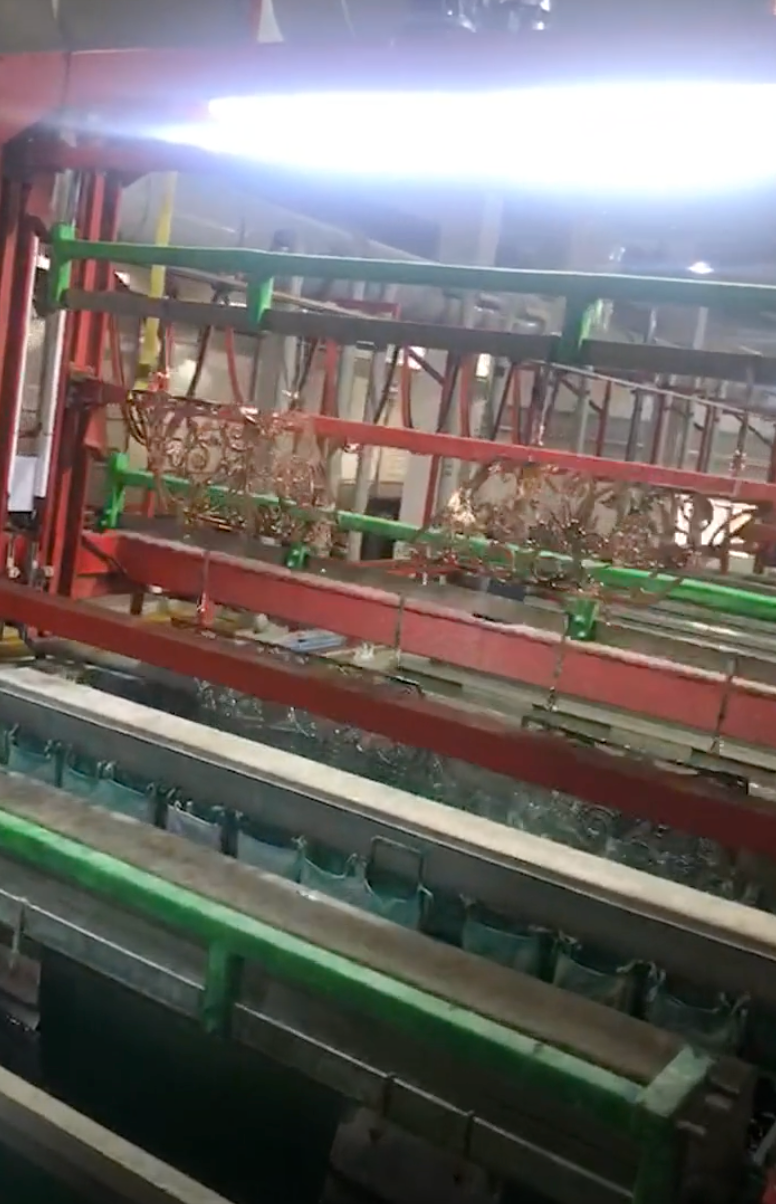
Traditional barrel plating often falls short when parts have recessed areas, sharp edges, or intricate internal pathways. Rack plating, by contrast, secures each component onto a custom fixture, allowing the current density and solution flow to reach every exposed surface with far greater precision. This fixturing approach becomes essential when a uniform coating is required across threaded sections, deep blind holes, or irregular contours that would otherwise trap gas bubbles or cause uneven metal distribution.
Beyond shape complexity, many applications demand selective deposition, where only certain zones of a part receive the plated layer. Rack systems enable this through precise masking, stop-off lacquers, or engineered anode placement. Instead of plating the entire surface, technicians can isolate functional areas such as contact points, bearing seats, or seal grooves, leaving other regions completely bare. This level of control reduces material waste and eliminates the need for secondary machining or stripping operations.
The real advantage emerges when production demands repeatability across thousands of parts with identical geometry. A well-designed rack not only positions each piece for optimal coverage but also accounts for solution agitation, drainage, and current distribution. Complex geometries that once required manual touch-up or scrap due to voids can now be processed with confidence, making rack plating the preferred method for aerospace fasteners, medical implants, and precision electrical connectors where both shape fidelity and selective functionality are non-negotiable.
Reel-to-Reel Lines for Continuous Strip and Precision Connector Plating
Reel-to-reel lines built for continuous strip and precision connector plating hinge on exact web handling rather than brute plating speed. Carrier strips as thin as 0.10 mm are pulled through multiple cells under closed-loop tension control, with dancer rolls and load cells correcting drift every few milliseconds. This keeps current density uniform across the full width, so gold, tin, or nickel deposits hold a consistent thickness even on parts with stamped cutouts and narrow contact beams.
The real differentiator on connector-focused lines is selective plating. Instead of flooding the entire strip, masks, shields, and custom anode geometries confine metal to the mating zone, the press-fit area, or the solder tail. A well-tuned line can maintain 0.75 µm of gold on a 0.2 mm wide contact target while leaving the rest of the strip bare or with a thin nickel underlayer. This cuts precious metal consumption by 40–60% compared to overall plating, without sacrificing insertion force stability or corrosion resistance.
Changeover between connector families rarely means rebuilding the line. Tooling plates, guides, and masks are designed to slide in and out as modular sets, with recipe-driven rectifiers adjusting ramp rates and pulse parameters per part number. Inline vision systems check for skip plating, nodulation, and band misalignment after the final rinse, then flag suspect sections before they reach the take-up reel. That level of traceability matters when a batch of 500,000 terminals has to meet a 50 µOhm contact resistance spec in automotive or high-speed data applications.
Vibratory Plating for Fragile Components That Can't Survive Barrel Tumbling
Barrel tumbling works fine for sturdy fasteners and stampings, but it quickly turns delicate parts into scrap. Thin-walled housings, ceramic substrates, glass-to-metal seals, or micro-connectors with fine pitch leads get chipped, bent, or fractured when they collide with heavier media and each other inside a rotating drum. Vibratory plating sidesteps that damage by replacing the tumbling action with gentle, high-frequency vibration that keeps parts suspended and moving without hard impacts.
The process relies on a vibratory bowl or tub where the components are immersed in a plating solution along with lightweight media. Instead of cascading and falling, the parts shuffle slowly in a circular or spiral motion. This low-amplitude movement is enough to ensure fresh solution reaches every recess, blind hole, and internal thread, but it avoids the battering that happens in a barrel. As a result, edges remain crisp, fragile flanges stay flat, and tiny contact surfaces retain their geometry.
For electronics assembly, medical device manufacturing, and aerospace sensor production, vibratory plating often becomes the only viable way to apply uniform gold, silver, nickel, or tin finishes without sacrificing part integrity. The trade-off is usually a longer cycle time compared to barrel plating, and it may require custom fixtures or media selection, but the reduction in scrap and rework makes it worthwhile for components where dimensional tolerance and surface quality are non-negotiable.
Automated Hoist Lines for Repeatable Process Timing and Consistent Bath Exposure
Automated hoist lines remove the guesswork from process timing by transferring racks or barrels along a fixed sequence with programmed dwell periods. Instead of relying on an operator to manually lift and move parts between tanks—where fatigue or distraction can shorten or lengthen immersion—the hoist follows a preset schedule every single cycle. This repeatability means that the first part run through a zinc phosphate bath gets exactly the same exposure as the five-hundredth part run later in the shift, regardless of who is on the floor.
Consistent bath exposure is not just about timing; it also involves controlled entry and exit angles, steady travel speeds, and synchronized lowering into each process tank. Automated hoists handle all of these variables uniformly, preventing splashing, uneven wetting, or partial submersion that can occur with manual handling. The result is a more predictable coating thickness, better adhesion, and fewer rejected parts—because every workpiece sees the same chemical environment for the same duration, batch after batch.
Enclosed Cleanroom-Grade Systems for Contamination-Free Gold Finishing
Achieving a flawless gold finish demands more than just precise chemistry—it requires an environment where airborne particles and process variability are engineered out of the equation. Our enclosed cleanroom-grade systems seal the entire finishing line behind controlled airflows, HEPA filtration, and positive-pressure barriers. This means operators never touch the workpiece between plating stages, and the risk of micro-contamination from dust, skin oils, or ambient humidity drops to near zero. The result is a gold layer with uniform thickness and a mirror-bright surface, batch after batch.
What sets these systems apart is their modular isolation architecture. Instead of retrofitting a conventional wet bench into a clean tent, each process cell—cleaning, activation, plating, rinsing, drying—is built as a sealed module with its own laminar flow hood and automatic transfer locks. Workpieces travel via robotic grippers or magnetic levitation trays through interlocked doors, never crossing a contaminated boundary. This design also simplifies validation: particle counts, temperature, and chemical exposure are logged continuously per module, giving you a defensible cleanroom record without the overhead of a full ISO-classified hall.
For high-value components like semiconductor lead frames, medical connectors, or precision optical mounts, even a single visible defect can scrap an entire lot. The enclosed system removes guesswork by controlling not just particles but also air ionisation and static charge—two often overlooked sources of gold finish irregularities. By keeping the microclimate stable and isolated from factory fluctuations, operators see fewer pits, nodules, or adhesion failures. The footprint is compact enough to install next to an existing plating line, yet the output consistency rivals far more expensive cleanroom expansions.
FAQ
For high-volume connector plating you want a reel-to-reel selective line rather than a general-purpose rack line. These systems move strip material through masking cells so gold is deposited only on the contact area, which keeps precious metal use down. Look for a line with precise tension control, adjustable masking belts, and rectifiers that ripple below five percent, because ripple directly affects deposit uniformity on small contact zones.
Manual lines make sense only for very low volume or unusual part shapes where flexibility beats speed. Semi-automatic works when operators still need to load and unload but you want consistent hoist movement and timing. Fully automatic pays off once daily throughput passes a few thousand parts because it removes the biggest variable in plating thickness: human timing. You also get better bath life because transfer delays and drips are controlled.
Rack lines give you better thickness distribution on complex or larger parts than barrel plating, so you might use less gold overall because you are not overplating to compensate for uneven coverage. They also reduce surface damage on delicate components. If your parts have recesses or require selective plating with conforming anodes, a rack line is often the only practical choice.
Ripple is the first thing, especially for gold because high ripple roughens deposits and wastes metal. Aim for less than five percent ripple at working current. Also check that the rectifier can hold constant current density across the full range you need, and that it has remote control capability if you plan to integrate automation later. Cheap rectifiers often drift when they heat up, which shows up as thickness variation from morning to afternoon.
Design the cell and racks or barrels so parts drain back into the gold tank for a few seconds before moving to rinse. Use low surface tension wetting agents but do not overdo it, since they can create foam. Then set up a two- or three-stage counterflow rinse with a drag-out tank that feeds a recovery unit. Some lines also use air knives or spray rinses directly over the gold tank to push solution back before the part leaves.
A turnkey line is already engineered so the rectifier, heater, filtration, ventilation, and transfer system talk to each other. You get one warranty and usually faster startup. Buying components gives you more freedom to mix brands and upgrade later, but you become the integrator. If you do not have in-house engineering time, hidden costs from mismatched plumbing, controls, and safety interlocks can erase the upfront savings.
High-speed gold baths run hotter and at higher current densities, so organic additives break down faster. You need continuous carbon filtration or at least daily carbon treatment to remove breakdown products. The gold concentration also drops quickly, so you need automatic dosing tied to amp-hours rather than manual adds. If the bath is not filtered well, you will see roughness first on high-current-density areas like edges and contact tips.
Yes, the most common is placing the gold tank next to an acid activation tank without proper exhaust separation. Acid mist drifts into the gold bath and changes its pH or contaminates it. Another mistake is cramped rinsing stations that let drag-out from a previous step contaminate the gold tank. Leave enough space for drip trays, good ventilation, and recovery rinses. A little extra floor space prevents a lot of rework.
Conclusion
Choosing a gold plating line is rarely about picking the most advertised setup; it comes down to part geometry, throughput, fragility, and how precisely the deposit needs to land. Barrel lines remain the workhorse for high-volume small parts, but modern designs use controlled rotation and current distribution to avoid the uneven gold thickness that used to plague loose-piece plating. Rack systems step in when components have recesses, threads, or require selective deposition through masking or shielding—giving an operator direct control over where gold does and doesn't go. For continuous strips and precision connectors, reel-to-reel equipment maintains tension, alignment, and contact timing to deliver repeatable plating on long runs without constant repositioning.
Fragile components that crack or bend in a tumbling barrel often move to vibratory lines, where gentle oscillation keeps parts separated while still exposing them to consistent solution flow. Automated hoist lines remove much of the human timing error from the process, repeating dwell, transfer, and bath exposure sequences with far less drift than manual handling. When contamination control becomes a hard requirement, enclosed cleanroom-grade systems use HEPA filtration, controlled airflow, and sealed tank areas to keep particles away from critical gold finishes. The ten configurations worth shortlisting all share one trait: they match the process to the part, rather than forcing the part into a generic line. That alignment—not raw throughput or plating speed—is what consistently yields gold layers with the right thickness, adhesion, and surface quality for demanding end uses.
Contact Us
Contact Person: hayyr
Email: [email protected]
Tel/WhatsApp: 8613082110525
Website: https://www.jundaelectroplating.com