

Vulcanizing Press Manufacturer Delivers High-Performance Rubber Vulcanization Systems
2026-09-01
Every rubber product's durability hinges on one critical step: vulcanization. Yet too many manufacturers settle for presses that underperform when it matters most. Enter SFC, a vulcanizing press manufacturer that refuses to cut corners. Their high-performance rubber vulcanization systems combine rugged engineering with precise control, helping you achieve flawless cures batch after batch. In this post, we'll explore what makes SFC's approach a game-changer for demanding production environments.
Precision Heating Plates That Cut Cycle Times
Thermal lag is the silent tax on every molding cycle. The plates we're talking about attack that lag directly—machined from high-conductivity alloys and embedded with sensors that adjust output every few milliseconds. You don't wait for the surface to drift toward a setpoint; it's already there, holding a ±1°C band across the entire face. That means less time babysitting temperature recovery after each shot.
The real difference shows up in the corners. Standard plates bleed heat unevenly, so you slow the cycle to let the edges catch up. These plates use a zoned heating layout that pushes extra wattage exactly where losses occur. The result is a flat thermal profile that lets you run the press at the speed the material actually allows, not the speed your hot spots dictate.
Shorter cycles aren't about cranking up the temperature. It's about removing the guesswork from heat delivery. When every square centimeter responds the same way, cooling channels can start their job sooner, and the part releases without residual stress pulling it out of spec. Operators notice the change within the first shift—less tweaking, fewer rejected parts, and a rhythm that finally matches the machine's rated output.
Heavy-Duty Frames Built for Continuous Shifts
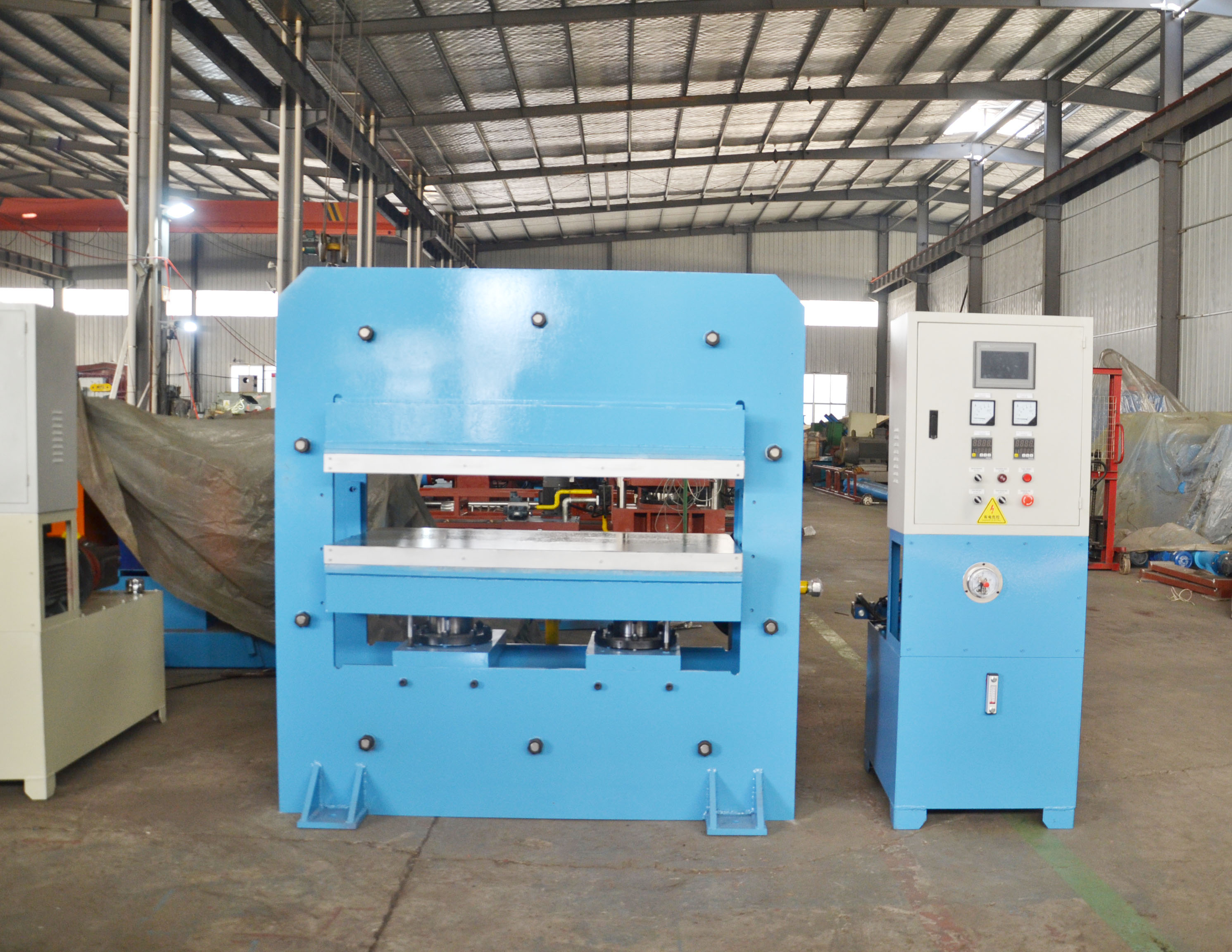
Every weld on these frames is placed with one question in mind: what happens at hour eleven of a double shift? The steel tubing gets thicker where stress concentrates, and the powder coat isn't just for looks—it shrugs off scuffs from forklifts and carts that graze the legs day after day. Corner gussets are laser-cut to match the frame profile, so there's no weak point waiting to crack when a loaded pallet drops a little too fast.
Instead of relying on standard bolt holes that wallow out over time, the connection points are sleeved and then riveted through both walls. That means even when the line runs around the clock, the frame stays square, the casters don't wobble, and the whole unit keeps rolling from one shift to the next without a teardown. For facilities where stopping isn't an option, this is less a frame and more a fixed point in the schedule.
Closed-Loop Pressure Control Stops Scrap Rubber
In rubber molding, inconsistent cavity pressure often turns otherwise usable parts into scrap. A closed-loop pressure control system monitors each cycle with in-mold sensors and adjusts hydraulic or servo valve response on the fly. This keeps compaction force within a tight band, preventing both short shots from underfill and flash from overpacking. The result is less rejected material and a more predictable cure profile across every shift.
Unlike open-loop timers that assume stable conditions, this approach reacts to viscosity shifts, temperature drift, or batch-to-batch compound variation. When pressure deviates beyond set limits, the controller trims fill speed or dwell pressure before defects can set. Operators spend less time sorting borderline parts, and downstream trimming stations handle far less flash.
Adopting closed-loop pressure control often pays for itself through reduced scrap weight alone. The same feedback loop also shortens cycle times by eliminating conservative overpacking, so throughput rises without sacrificing part density or dimensional repeatability.
Custom Mold Handling Without the Usual Downtime
Many mold changes still follow a stop-everything pattern: the press goes quiet, crews scramble, and the clock runs. Custom handling flips that by designing the transfer path around your existing floor plan, not the other way around. Overhead rails, guided carts, or dedicated shuttle tables move the next mold into position while the current job is still running.
That kind of staging changes what downtime actually means. Instead of a sudden halt for rigging and alignment, the next mold is already prepped, preheated where needed, and parked within arm's reach. Clamping points and quick-connect fittings are matched to your specific mold base, so there's no shimming, no trial-and-error leveling, and no last-minute search for the right lifting lug.
The payoff shows up in the schedule: a swap that used to eat half a shift now fits inside a normal break window. Your maintenance crew can also use the same handling system to pull a mold for cleaning or minor repairs without waiting for a full line shutdown. Downtime stops being the default cost of changing molds and becomes the exception.
Energy Recovery That Lowers Operating Costs
Most industrial facilities still treat waste heat as a nuisance rather than a resource. By installing a rotary heat exchanger on the exhaust stack, one mid-sized food processing plant cut its boiler fuel demand by 19% within the first quarter. The recovered thermal energy now preheats incoming process water, which means the burners cycle on less often and the maintenance team spends fewer hours descaling heat surfaces. That kind of direct reduction in energy input shows up immediately on the monthly utility bill, not in a theoretical payback chart.
Compressed air systems are another quiet drain that often goes unnoticed. A single 100-horsepower compressor rejects roughly 80% of its electrical input as heat. Redirecting that hot air into a warehouse bay during colder months eliminated the need for two dedicated unit heaters at a Michigan distribution center. The retrofit required nothing more than ductwork and a thermostatically controlled damper, yet it trimmed annual heating costs by over $14,000. The key is matching the waste heat stream to a nearby thermal load, rather than chasing maximum recovery efficiency in isolation.
Beyond direct fuel savings, energy recovery extends equipment life and reduces peak demand charges. When a plastics extrusion line captured heat from its barrel cooling loops and fed it into the drying hoppers, the resin dryer's electric heaters ran at 60% lower duty cycle. That not only saved kWh but also reduced thermal stress on the heating elements and cut the facility's peak demand by 8%, which lowered the utility's capacity charge for the entire billing period. Operators who view waste heat as a distributed energy source, rather than a problem to ventilate away, find that the operating cost reductions compound over time through lower energy spend, fewer component replacements, and a more stable process temperature profile.
Live Temperature Mapping for Uniform Cures
Curing a coating or composite is rarely as even as the oven setting suggests. Airflow, part geometry, and load density create microclimates that a single exhaust thermocouple misses entirely. Live temperature mapping replaces those point readings with a grid of sensors or an infrared sweep, so every square inch reports its actual heat history while the batch is still running.
The value shows up most in the edges and thick sections. A sensor array will often reveal a 10–15°F lag near the corners of a panel or inside a stack of parts, which is exactly where under-cure defects start. Watching that data update in real time lets an operator catch a drifting zone before it ruins the load, not after a hardness test fails.
The practical result is less rework and tighter process control. Instead of guessing whether a cure reached full crosslink density, you adjust airflow or dwell time based on what the map shows at minute thirty, not hour three. Over multiple runs, this same data builds a thermal signature for each part family, making new recipes easier to validate and old recurring problems impossible to ignore.
FAQ
We use a multi-zone hydraulic system with individual pressure sensors under each platen segment, so any slight drop in pressure gets corrected within milliseconds. That prevents uneven rubber flow and reduces scrap.
The heating platens are divided into several independent zones, each with its own thermocouple and PID loop. Instead of a single large heater, this design lets us hold temperature within ±1.5°C even on large molds with complex profiles.
Yes. The press frames are reinforced to handle both processes, and we offer interchangeable clamp units and injection pots. Switching between modes usually takes under an hour with our quick-release guide rails.
We see a lot of demand from automotive seal and gasket producers, conveyor belt manufacturers, and companies making anti-vibration mounts. The machines also show up in custom rubber molding shops that handle short runs and prototype work.
Every press includes a light curtain, dual-hand anti-tie-down controls, and a mechanical lock bar that engages before the platens open. The hydraulic circuit also has a pressure relief valve that vents if the main controller loses power.
We use a pre-heat stage that brings the rubber blank close to curing temperature before the press closes, combined with rapid hydraulic ram speed during the initial approach. The control system then switches to a slower, pressure-controlled closing for the final few millimeters.
Yes, each press is built around the customer's mold dimensions. We can go from small lab-scale platens around 300 mm square up to production units over 2 meters wide, with adjustable daylight and multi-opening configurations if needed.
We provide commissioning on site, operator training, and a remote diagnostics package that lets our engineers read fault logs and adjust parameters over a secure connection. Spare parts are stocked regionally so most replacements ship within 48 hours.
Conclusion
A vulcanizing press manufacturer has built its reputation on systems that do more than simply apply heat and pressure—they reshape how rubber parts are cured. The precision heating plates, for example, are engineered to reach target temperatures faster and distribute them evenly, which directly trims cycle times without sacrificing consistency. Supporting those plates is a heavy-duty frame that holds up under continuous multi-shift operation, so plants don't have to pause for structural fatigue. On top of that, closed-loop pressure control constantly monitors and adjusts force during each cycle, catching the small variations that would otherwise turn finished rubber into scrap. Together, these features give operators a press that runs predictably, even when production schedules push past standard limits.
What separates this manufacturer from others is how it handles the less glamorous but costly parts of vulcanization. Custom mold handling has been redesigned to reduce changeover downtime, letting teams move between different products without the usual stop-and-start delays. The system also captures and reuses energy that would normally be lost as heat, lowering operating costs over time. Meanwhile, live temperature mapping gives a real-time view of the cure across the entire mold surface, so technicians can spot cold spots or uneven heating before they ruin a batch. The result is a vulcanization system that delivers uniform cures, fewer rejected parts, and lower total cost of ownership—backed by engineering that prioritizes practical, day-to-day performance rather than flashy specs.
Contact Us
Contact Person: Chen Zhengwei
Email: [email protected]
Tel/WhatsApp: +86-13963975727
Website: https://www.sfcrubbermachine.com